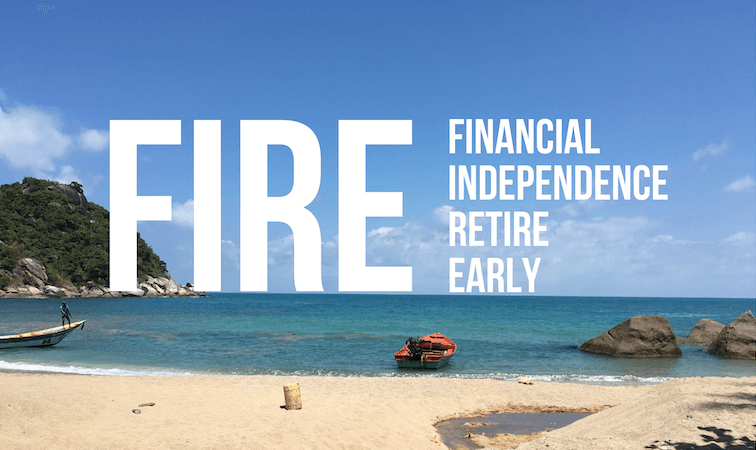
You've probably seen the acronym floating around financial Twitter, YouTube thumbnails, or Reddit threads. FIRE — Financial Independence, Retire Early. It sounds aspirational, maybe even unrealistic. Retire early? In this economy?
But FIRE isn't really about retiring at 30 and sitting on a beach. It's a financial framework — a set of principles for building enough wealth that work becomes a choice, not a requirement. And once you understand the mechanics, you start to see why it could be one of the most relevant financial concepts for young Africans today.
The basics: what FIRE actually means
At its core, FIRE is built on one idea: if your investment portfolio generates enough passive income to cover your living expenses, you no longer need a salary. You've reached financial independence. What you do after that — keep working, start a business, travel, build something — is entirely up to you.
The framework has two moving parts.
Your FIRE number is the total portfolio value you need to reach financial independence. The traditional formula is simple: take your annual living expenses and multiply by 25. So if you spend $20,000 a year, your FIRE number is $500,000. The logic comes from the "4% rule" — the idea that withdrawing 4% of a well-invested portfolio annually should sustain you indefinitely without depleting the principal.
Your savings rate determines how quickly you get there. The higher the percentage of your income you invest, the shorter your timeline. Someone saving 20% of their income might take 35 years to reach FIRE. Someone saving 50% could get there in under 15.
That's the entire engine. Earn, save aggressively, invest consistently, and let compounding do the heavy lifting over time.
The three flavours of FIRE
Not everyone pursuing FIRE is chasing the same lifestyle. The community has evolved into distinct approaches based on how much you plan to spend in retirement.
Lean FIRE is the minimalist path. You target the lowest reasonable cost of living — cutting expenses to essentials and retiring on a smaller portfolio. Think a single person living simply in a lower-cost city, spending $8,000–$10,000 per year.
Comfortable FIRE is the middle ground. You maintain a solid quality of life — decent housing, regular travel, healthcare, the occasional indulgence — without extravagance. Depending on where you live, this could be anywhere from $18,000 to $57,000 per year. Location matters enormously.
Fat FIRE is for those who want financial independence without compromising on lifestyle. Premium housing, private healthcare, international travel, and full financial security for a family. This typically means $35,000–$85,000 per year or more.
The approach you choose doesn't just affect how you live — it fundamentally changes how much you need to save and how long it takes to get there. And critically, it depends heavily on where you plan to live. A comfortable lifestyle in Lagos costs a fraction of the same standard of living in London or Houston — which has massive implications for your FIRE number.
Why the 4% rule is only half the story
The 4% rule was developed in the 1990s by American financial planner Bill Bengen, based on historical US stock market returns and US inflation data. It assumes your portfolio grows at roughly 7% per year (after inflation) and you draw down 4%.
It works reasonably well in low-inflation, mature-market economies. But it was never designed for environments where inflation runs at double digits, where currency volatility is real, and where the available investment options look nothing like the S&P 500.
This is where things get interesting.
In markets with higher dividend yields, the calculus changes. If your portfolio yields 10% in dividends instead of 1–2%, you could potentially fund your retirement through dividend income alone — without ever touching the principal. You wouldn't need to withdraw 4% of anything. You'd be living off the yield.
The 4% rule assumes you're slowly drawing down your portfolio over 30 years. A dividend-driven strategy, if the yields are high enough and sustainable enough, means the portfolio stays intact — or even keeps growing. It's a fundamentally different model.
Whether this works in practice depends on the specific yields, the inflation rate, the reinvestment strategy, and the stability of the underlying businesses paying those dividends. But the possibility is real enough that it deserves serious consideration — especially for anyone investing in markets where yields significantly exceed Western norms.
The variable that changes everything: inflation
In the standard FIRE playbook, inflation is almost an afterthought. American planners assume 2–3% and move on. That assumption is baked into the 4% rule itself.
But inflation isn't a universal constant. It varies enormously between countries and regions. And at higher rates, it doesn't just erode purchasing power — it fundamentally rewrites your FIRE number.
Here's why: your FIRE number isn't static. If you plan to retire in 15 years and inflation is high, the cost of living could multiply several times over by the time you stop working. A lifestyle that costs $18,000 today could cost $70,000 or more by the time you reach financial independence, depending on local inflation.
This means country-specific planning isn't optional — it's essential. A FIRE plan built for one city or country looks fundamentally different from one built for another. The cost of living, inflation rate, available investment returns, and currency dynamics all shift the equation. Using generic American defaults for a life that will be lived somewhere else isn't just inaccurate — it's potentially dangerous.
FIRE in the African context: it's not about quitting
In the West, FIRE often gets framed as an escape from work. Grind for 10–15 years, accumulate enough, and walk away.
That framing doesn't resonate everywhere, and it probably shouldn't.
For many people — particularly in emerging economies — financial independence isn't about escaping work. It's about having the freedom to do work that matters. The ability to start a business without the existential risk of missing rent. To care for aging parents without depleting your own future. To invest in your community, fund a side project, or simply negotiate life from a position of strength rather than dependency.
In regions where formal pension systems are thin, where social safety nets are limited, and where many adults simultaneously support older parents and younger children, financial independence isn't a lifestyle trend. It's a practical necessity. The question isn't whether you can afford to pursue it — it's whether you can afford not to.
FIRE gives a name and a framework to something many people in these contexts already intuitively pursue: building financial security through ownership, not just income.
Getting started: the fundamentals
If you're new to FIRE, the path forward is straightforward even if it isn't easy.
Know your numbers. What do you spend per month? What do you earn? What's the gap between the two? The distance between your income and your expenses is your savings rate — and it's the single most important number in your FIRE journey.
Pick your target. Decide which flavour of FIRE fits your goals — lean, comfortable, or fat — and crucially, for which country. Your annual expenses, adjusted for local inflation, determine your FIRE number. Get this wrong and the rest of the plan doesn't hold.
Invest consistently. Not in savings accounts yielding 3%. In productive assets — equities, real estate, dividend-paying stocks — that grow faster than inflation. The specific instruments depend on where you invest and what yields are available, but the principle is universal: your money must work harder than inflation.
Reinvest your dividends. Early in your journey, every dividend payment should go back into your portfolio. Compounding is exponential, and the difference between reinvesting and withdrawing dividends over 15–20 years is enormous.
Think long-term. FIRE isn't a sprint. It's a 10–25 year project depending on your savings rate and returns. The earlier you start, the more time works in your favour — and time is the single most powerful variable in the equation.
Where this goes from here
The FIRE conversation has been dominated by Western voices for over a decade. The principles are universal — save aggressively, invest wisely, let compounding work — but the application has been narrow. The inflation assumptions, the investment options, the cost-of-living benchmarks — all of it has been built for one type of economy.
That's starting to change. And the place where the shift matters most is Africa — a continent with the youngest population on earth, fast-growing markets, high dividend yields, and a structural pension gap that makes financial independence not just attractive, but essential.
In our next piece, we go deeper into exactly that: Why FIRE Could Reshape How a Generation of Africans Builds Wealth — the demographic window, the yield advantage, the cost-of-living arbitrage, and why the math looks completely different when you stop using American defaults.